Meet for yourself.
Bring your people
with you.
Swipe Right is a trust-first relationship platform built for Africa — combining modern matchmaking with the family, community, and cultural networks that have always shaped how people find relationships.
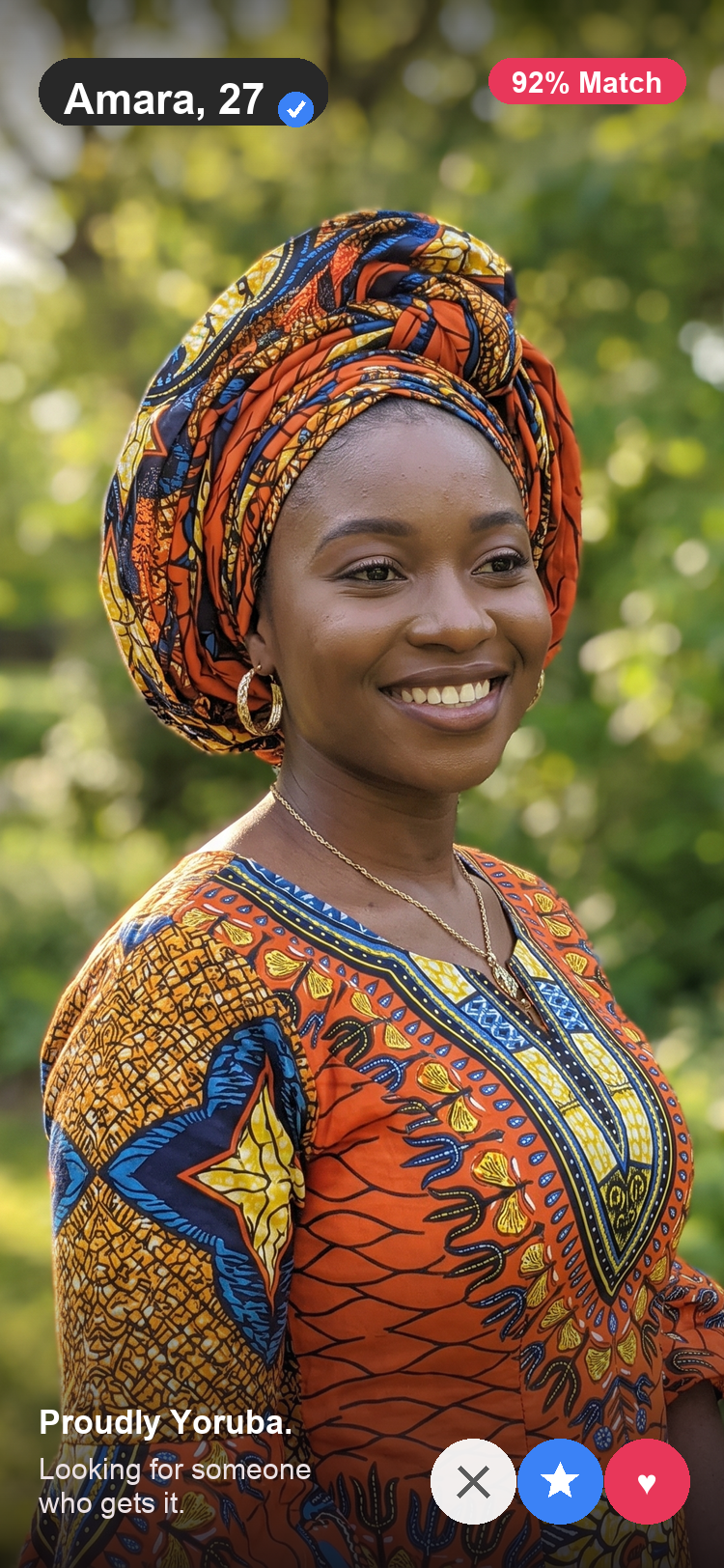
Dating has moved online. But trust hasn't. Parents, families, and trusted communities still care deeply about who their children build relationships with — dating apps just left them outside the process.
INTERPOL's 2025 Africa Cyberthreat Assessment names social media, messaging apps, and online dating platforms as primary channels used to cultivate relationships for fraud, including romance scams. Source →
Dating went digital. Families didn't.
For generations, relationships were shaped by family introductions, friends and trusted networks, religious communities, shared social circles, and cultural connection. Social media changed how people meet. Dating apps changed how people discover each other. Neither was designed around the question that matters most when an online connection becomes a real-world relationship: can I trust this person?
Discovery + Compatibility + Trust + Community
Instead of optimizing for endless swiping, Swipe Right is designed around the journey from meeting someone to building something real. Every user builds a dynamic Trust Profile as they use the app — some of it shown, some of it feeding an internal Trust Score that quietly shapes who they're shown and who can reach them.
Liveness verified, not just "photo uploaded"
Phone verification, a live selfie check, and account-age signals — a verified badge means a real, live human sat in front of the camera, not that someone ticked a box.
Structured, not a bio line
Marriage, long-term, serious dating, open to seeing where it goes, friendship — declared upfront as a non-negotiable field, with a timeline (now, 6 months, 1–2 years, eventually) attached to it.
Conversation quality, not just report counts
Consistency, report history, and suspicious-pattern detection feed the same score — someone who's been reported three times looks different in the system than someone who's had one bad match.
Scam and manipulation signals, scored
Financial-solicitation language, manipulation patterns, and community reports roll into a scam-risk signal attached to the account, not buried in a support queue no one reads.
Not "who do you find attractive." "What do you actually want."
AI matching on photos alone is table stakes now. Swipe Right's intelligence is relationship intelligence: who you are → what you want → who you're compatible with → who is trustworthy → whether the connection is actually progressing.
💍 Marriage · ❤️ Long-term · 💬 Serious · 🌱 Open · 👋 Friendship
Paired with a timeline — now, 6 months, 1–2 years, eventually, unsure — so two people who want fundamentally different things never get matched on looks alone.
Family, faith, children, location, finances — asked, not guessed
Religion, family expectations, children, career ambitions, communication style, financial philosophy, and cultural preference all feed the compatibility score — the dimensions that actually predict whether a relationship holds up.
A compatibility breakdown, not a single number
Values, lifestyle, communication, relationship goals, and location each get their own score, so "91% compatible" means something a user can actually inspect — not a black box.
Designed for the whole journey, not a report button
Most competitors treat safety as a support-ticket afterthought. Guardian is a product pillar that covers before the chat, during the conversation, before the date, during the date, and after it.
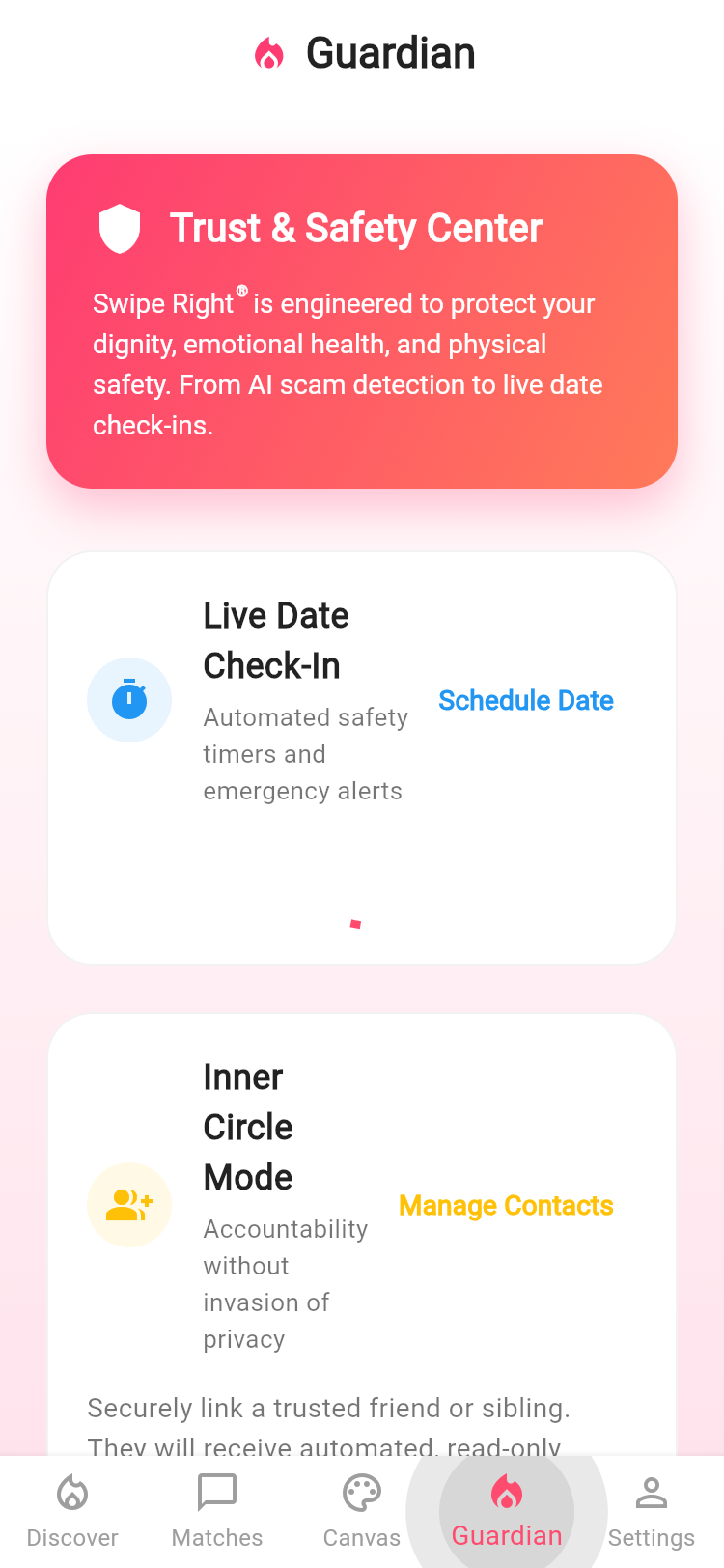
The Date Passport
Before two people meet in person, each side sees exactly what the system knows — a concrete artifact that makes Swipe Right feel like a fundamentally different product from a swipe stack.
- Identity verified
- Liveness verified
- Phone verified
- Profile active 8 months
- No safety reports
- Mutual compatibility: 87%
The Circle
Parents and trusted people shouldn't control who you date. But they shouldn't have to be completely excluded either. Swipe Right lets users create a private Circle of people they trust — mum, dad, a sister, a best friend, an auntie, a mentor — and decide exactly what that Circle can see. Parents advise. Users decide.
- Verified identity
- Basic profile
- Compatibility summary
- Date location
- Date time
- Safety status
- Private conversations
- Personal messages
- Private photos
Family introductions don't have to disappear
A user can opt in to introductions — a trusted person from their Circle can recommend someone from their own network, powered by the same verification and compatibility scoring as any other match.
- Identity verified
- Introduced through a trusted connection
- Relationship goals aligned
- 89% compatibility
From discovery to a real relationship
A wedge, not a ceiling
Africa doesn't need another copy of a Western dating app. It needs a product that understands relationships are rarely just between two individuals — family matters, culture matters, religion can matter, community matters, reputation matters, safety matters. Young Africans are navigating all of this through smartphones and social platforms already; Swipe Right bridges traditional trust with modern discovery. We're not pitching "a dating app for Africa" — it's 54 highly diverse countries with courtship norms that differ by country and city — so the wedge is specific: Lagos first.
GSMA estimates mobile technologies contributed $240B to Africa's economy in 2025, with continued growth through 2030 — a mobile-first, rapidly digitizing base with an acute, underserved trust problem. GSMA → · Market fragmentation →
Two flywheels, not one
Optimizing for successful connections instead of swipe volume compounds twice — once on match quality, once on marketplace safety.
Build the trust layer for relationships in emerging markets
Dating is the starting point. Swipe Right can become the infrastructure connecting people, trusted communities, and relationships in a digital world.
We're not trying to win by having the most swipes
Four advantages, built to compound rather than to be copied in a sprint.
Identity, behavioral, and safety signals
Together they create a higher-quality network than a stack of unverified photos ever can.
Every interaction improves the model
Match → conversation → date → relationship outcome feeds back into compatibility and trust scoring.
Designed around, not translated for
The product is built for African relationship dynamics from the ground up, not a Western app with new copy.
Users bring trusted people into the ecosystem
The Circle and Family Introductions extend the network beyond individual daters — a moat competitors can't retrofit onto an existing swipe-first product.
Most dating apps optimize for swipes → matches → engagement. Swipe Right optimizes for meaningful connections → safe dates → successful relationships. The question isn't how many people you swiped on — it's whether we helped you meet someone worth building a relationship with.
Respect starts with not translating culture into English
Kiswahili, Yorùbá, Amharic, and isiZulu ship today, alongside 22 other languages — not a checkbox, but because a conversation that has to happen in someone's second language already costs them part of themselves.
This is a starting point, not a finished thesis — we're building this with the communities it's for, not assuming we already know their courtship norms better than they do.
Freemium, with three ways to go deeper
Free membership drives the network and the trust graph; three subscription tiers monetize the users who want more control, more visibility, or more reach.
- See who already likes you
- New curated top picks daily
- 5 Super Likes a week
- Priority placement on likes sent
- Message a match before they swipe back
- Everything in Gold
- Unlimited likes
- Unlimited rewinds
- Ad-free browsing
Built on Google Cloud, from day one
Swipe Right runs on Firebase — Google Cloud's application platform — end to end: identity, database, file storage, and server logic. That means the app inherits Google's infrastructure for uptime, security, and scale instead of us having to build and operate our own.
26 markets, one build
Every screen — onboarding, chat, safety flows, paywalls — is localized, so expanding into a new country is a language switch, not a re-platforming project.